The Capital
The Reincarnated Demon King's Host Just Wants to Live in Peace, But the Hero Won't Leave Him AloneThe Capital is the political, military, and magical center of Algeya, but its importance is not merely administrative. It is the place where the kingdom converts gifted children into instruments of war, where the state monitors the boundary between human safety and demonic threat, and where Theo is repeatedly forced to choose between obedience and the people he loves. To Theo, the city is first a prison of walls and crowds; later, it becomes the site where his hidden identity is demanded, exposed, and contested before the whole country.
Structure and Political Function
The palace at the very center of The Capital is divided into two halves joined by a courtyard. One half houses King Alexis and his family and accommodates councils and balls. The other trains magic users and knights destined either to serve the royals or to join the Hero’s party. This arrangement makes the palace a miniature map of Algeya’s governing order: ceremony, legislation, magical expertise, military preparation, and heroic service occupy one connected institution rather than separate spheres. The city’s centrality also reflects the political unity of Algeya. The country is organized into kingdoms associated with the mortal races, while the orcs remain more nomadic, and people may live and travel across borders with relative ease. That cooperation was forged in response to the demons. Even after Malthios’s defeat, remnants of his army remain under the surviving Demon Lords, so the Hero’s party continues to protect ordinary people. The Capital therefore presents itself as the guardian of a fragile peace, while also preserving the emergency structures created by the continuing demonic threat.
Theo’s First Arrival and Magical Selection
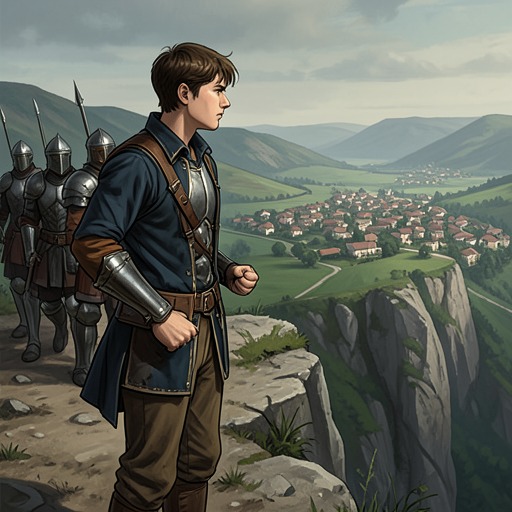
Theo’s first experience of The Capital is one of sensory and social oppression. Coming from a small village surrounded by forests and farms, he finds the walls, tall buildings, and mass of people so overwhelming that he feels caged. The city exposes him to more races than he had known at home, yet that widening of the world does not make him feel free. He already knows that he will escape at the first opportunity, and much of his knowledge of the wider land comes from books or from Malthios’s memories rather than personal experience. The magic test takes place in a great hall before the King and his council. Children of different ranks and races wait together while people representing different magical disciplines prepare to claim those with useful abilities. The process resembles an auction: the children’s gifts determine who may take possession of their futures. A giant orb senses the magic of anyone who touches it; without magic, it remains dark. Theo fears that the test will reveal Malthios’s power inside him and lead to his immediate execution, and his agitation nearly allows Malthios to emerge. Instead, the orb reveals Theo’s own deep emerald-green healing magic, a glow so intense that it blinds everyone present before fading. The result does not grant Theo independence. When the court mage declares that a gift of this magnitude belongs in the Hero’s party, the city’s institutions claim him immediately. He is sent to study under the greatest healer in Algeya, a priest who once served in Eliza’s party and lost the use of both legs in the final battle against Malthios. The Capital thus establishes the pattern that governs Theo’s life: his talent is praised, but the praise functions as a justification for conscription. His parents are disappointed because the result will not benefit them, while the state treats his ability as a resource that must be directed toward the next Hero.
The City as a Place of Compulsion and Return
The Capital remains the destination assigned to Theo even after years of training. On the day he turns sixteen, Camden tells him that guards will collect him and bring him back to meet the new young Hero and the Hero’s companions. They are expected to train together until the Hero comes of age, after which they will inherit the duty of purging the remaining demons and protecting the common folk. Rather than submit, Theo packs his few belongings and food, leaves without even a note for Camden, and travels with Malthios for two years, taking odd jobs and moving steadily north. The peaceful village they eventually find seems beyond the reach of both demons and Heroes, although Theo’s confidence in that refuge proves mistaken. The Capital’s power lies in its ability to turn distance into temporary freedom rather than permanent escape. Theo knows that friendship alone will not save him if anyone discovers what he is, and the city represents the institutions capable of transforming discovery into arrest or execution. When Cargo later asks whether Theo will tell the others that he is demon spawn, the question makes Theo freeze and prompts Malthios to push toward control of their body in self-defense. The Capital is already present in that reaction: its authority has taught Theo to experience disclosure as a potentially fatal event. That threat becomes immediate when Luc is injured by a demon shortly before the party reaches The Capital. A portal opens in Leafel’s main square, a high-level spell requiring exceptional mana or several mages, and Bryony and Wicker use it to bring Theo to the city because Luc has a deadly fever and the capital mages have failed to wake him or cure him. Theo understands that crossing the portal will end his autonomy. The people in power will know where he lives, the court mage may recognize him, and Camden will certainly know who he is. He expects to be forced into the Hero’s party, where the truth about Malthios could be exposed, but he goes because Luc may die. The city is therefore both the danger he has fled and the place he must enter to save someone who matters more to him than his own safety. Theo’s arrival through the portal is deliberately ordinary in its physical sensation: it feels like stepping through a doorway, with summer warmth replaced by the cold of a stone building. Politically, however, the threshold is absolute. Before he can regain his bearings, the court mage confronts him with cold hostility and uses the pressure of her mana as an intimidation technique. The Capital turns a simple act of rescue into a renewed encounter with state power.
Palace, Training Grounds, and Public Authority
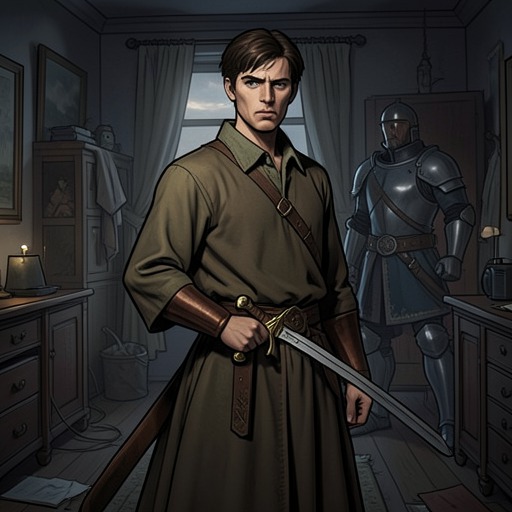
After Luc begins recovering, Theo hopes to return home, but the King and council demand an audience. The throne room is less crowded with physically present people than Theo remembers because magically enchanted mirror spells display the reflections of rulers in distant meeting rooms. The absent rulers’ images shine with gold, allowing the different kingdoms of Algeya to conduct council without the exhausting cost of repeated portal travel. The room’s technology makes authority seem simultaneous and omnipresent: a ruler need not be physically present to watch, judge, or participate. King Alexis, ruler of the human kingdom of Rizaah, receives Theo from the throne. The King’s body shows the passage of more than twenty summers since Theo last saw him, with deep lines around his eyes and hair that has turned mostly gray. Camden is present in a wheelchair, along with guards and the court mage. Theo keeps his chin raised and his posture casual, but Malthios trembles within him. He scans the room for Eliza and relaxes slightly when he finds no sign of her, revealing how strongly the palace is associated with both political command and personal danger. The training courtyard offers a different face of the same system. Theo joins the Hero’s party there after breakfast, while knights drill nearby and Syvia and Camden observe. The other party members welcome him with hugs and enthusiastic slaps, although Avery and Emi remain sour and the court mage watches him narrowly. The courtyard is not a refuge from authority; it is the place where affection among the party is placed under observation and where Theo’s return is folded back into the military routine. When Luc is cleared to resume his quest, the party prepares to leave The Capital, and Luc takes Theo to the armory to obtain a weapon suitable for fighting demons. Theo’s ordinary knives are judged insufficient, so the city equips even its healer for the violence expected beyond its walls. When the party finally leaves, the city’s public recognition becomes another form of pressure. The people part for the group, watch them pass, and sometimes bow, while the party receives friendly waves. Theo finds the crowded streets worse than before because attention now follows him as a member of the Hero’s party. Luc keeps hold of Theo’s wrist until they reach the open road and The Capital grows smaller behind them. The gesture contrasts private protection with public display: the city makes the party visible as symbols, while Luc tries to guide Theo physically out of its reach.
The Capital as Courtroom and Prison
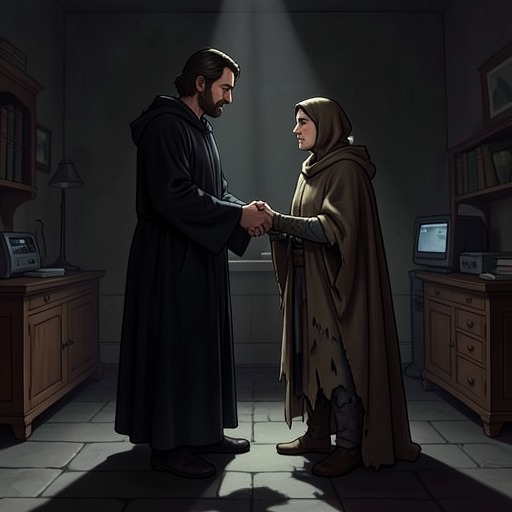
The city’s most consequential transformation occurs when Theo’s identity as Malthios’s host is confirmed. Avery uses a magic scroll to contact the court mage, and the party’s rare Portal Orb opens a route to The Capital by breaking the item. Within ten minutes of Theo putting on the Magic-Dampening Handcuffs, the group arrives in the capital courtyard, where a dozen knights and the court mage await them. Instead of offering an audience or medical explanation, the court mage orders Theo taken to the dungeons. Luc has said nothing since Theo confirmed the truth, and Theo cannot look at him as he is led away, experiencing the city’s return as the severing of the relationship that had made the journey bearable. The dungeon leads directly into a public spectacle of judgment. The throne room is filled almost as densely as the hall where Theo’s magic was tested years earlier. Mirror spells show glimpses of other meeting rooms, while members of the court line the chamber. Syvia and the haunting form of Eliza stand beside the King’s throne; the Hero’s party stands opposite them, with Veiv, Khal, Wicker, and Cargo watching, Avery and Emi glaring, and Bryony looking down at her feet. Theo is forced to his knees beneath a round mirror angled toward him, a magical device broadcasting the proceeding to every town, village, and city in Algeya. The private secret that once governed Theo’s movements is converted into national knowledge. The trial is a political continuation of the magic test. Earlier, the city measured Theo’s body, identified his healing power, and assigned him to the Hero’s party. Now it measures the same body as a security threat and assigns guilt for protecting Malthios. In both scenes, a central audience, magical technology, and institutional officials define what Theo is allowed to be. The difference is that the green radiance of the healer has become the legal stigma of the Demon King’s host, and the child once claimed for service is now confined for resisting the role imposed upon him. The Capital’s claim to total authority is interrupted by Leafel. A new mirror spell opens beside Syvia, showing Leafel’s familiar town square and a crowd gathered there. Micah stands at the front with his staff raised, performing a spell remarkable for someone of his age and level. Imani, Dale, Dmitri and his parents, Nib, Amaya, and the people of Leafel stand behind him, while Hayden steps forward and demands Theo’s release on behalf of the town. Theo realizes that the people he feared would abandon him have come publicly for him instead. The contrast defines The Capital’s narrative significance: the city can imprison Theo, expose him, and broadcast his alleged guilt, but it cannot fully control the communities and relationships that give him an identity beyond the state’s categories.
Spatial Meaning and Narrative Significance
The Capital is built as a hierarchy of access. The palace connects royal residence, council chamber, magical training center, and military preparation; the courtyard and training grounds organize bodies for service; portals provide rapid movement but also expose travelers to institutional capture; the dungeon removes autonomy; and the throne room’s mirrors extend judgment across the entire country. Each space offers a different degree of freedom, yet all remain connected to the same governing apparatus. For Theo, movement toward The Capital repeatedly means movement toward an imposed identity. His first entrance makes him a child selected for his healing magic. His flight north turns the city into the origin point of exile. His return through the portal is an act of love performed under threat. His later departure with Luc and the party is a temporary escape from surveillance, while the broken Portal Orb and Magic-Dampening Handcuffs reverse that escape and bring him back as a prisoner. The city’s roads and thresholds therefore chart not only geography but changing legal and emotional status. At the same time, The Capital is not presented as an undifferentiated evil space. It coordinates the kingdoms of Algeya, trains defenders, supports the Hero’s party, uses mirror magic to connect distant rulers, and contains healers whose work protects people damaged by war. Its danger comes from the way legitimate protective functions can absorb individual lives. The same system that needs Theo’s healing can conscript him, the same court that claims to preserve peace can turn him into a public example, and the same magical infrastructure that links the country can broadcast his humiliation. The Capital’s decisive significance lies in this contradiction: it is the fortress built to defend Algeya, yet for Theo it becomes the most concentrated expression of the power from which he must be defended.